

June 18, 2026



Orange Slovensko runs 130 RPA processes in production today. Not pilots, not demos for management: automations that handle real work every day and save 43,000 hours a year.
Numbers like that don't appear overnight. Behind them are several years of work between Hyverr and Orange Slovensko, from the first plans to an operation you can rely on. And it's still going.
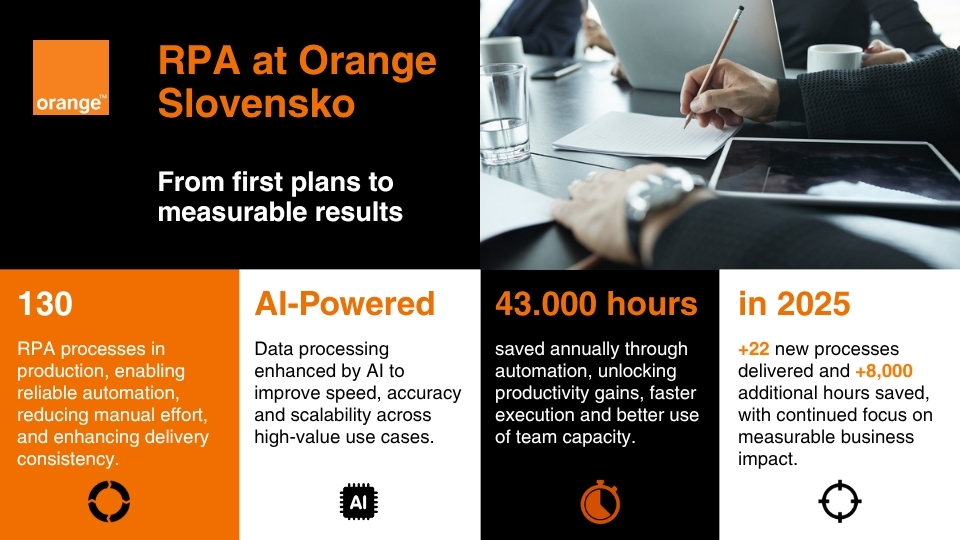
Production is the toughest test in automation. A process that survives it has to run repeatedly, without hand-holding, with a predictable result. That's the job of those 130 automations: they take manual work off people's plates and hold delivery consistent, day after day.
It sounds obvious. It isn't. The applications the robots work in keep changing: logins, forms, dropdowns, edge cases. A robot nobody looks after will eventually break. Keeping 130 of them running takes constant, invisible care, and that care is exactly what separates a mature automation setup from a pile of scripts.
For the teams, the result is simple: less retyping and checking, more capacity for the work a robot can't do for them.
Delivering a single robot is a sprint. Running a program of 130 processes is a different discipline.
The collaboration covers the full automation lifecycle: picking the right processes, building them, and supporting them in daily operation. New processes come on gradually, at a pace the operation can absorb.
Time also works in our favor. Lessons from production feed back into new development, so what proves out on one process makes the next ones faster and cheaper to build. On programs measured in years, that effect compounds.
Forty-three thousand hours a year reads easily and pictures poorly. Against a typical working year of around two thousand hours, it's the equivalent of more than twenty full-time people. Every year. And it's capacity you don't have to find through hiring or overtime: it comes out of the teams you already have.
Hours are an honest metric, too. You can't inflate them with adjectives, and you can compare them year over year. That's why one principle holds the whole partnership together: nothing gets automated just because it technically can be. Measurable business impact is the condition, not the bonus.
RPA handles anything governed by clear rules: same steps, same fields, same format. The moment data stops arriving in a consistent shape, rules stop being enough.
That's why data processing at Orange Slovensko is reinforced with AI. It's faster and more accurate. More importantly, it scales to high-value cases, the ones where work used to stay with people simply because it was too varied for a robot.
Combining the two moves the line on what's worth automating at all.
Automation programs tend to slow down after a few years. The easy processes run out, and every new candidate costs more effort than the last.
Something different happened here: 22 new processes went into production and another 8,000 hours were saved. After several years of working together, that may say more than the size of the program itself. The environment is still growing, and it's growing where the benefit can be proven.
After several years of working side by side, our thanks go to the team at Orange Slovensko. Their trust and open communication are the reason the first plans turned into 130 processes in production. We don't take that for granted.
Building automation is one thing. Keeping 130 processes running so they're still reliable tomorrow morning is the other, less photogenic half of the job. And that's where it's decided whether the numbers on the slides hold up next year too.